
Some of the most repeated Excel advice online is either outdated, incomplete, or simply wrong.
You may have heard things like:
“Don’t use Tables, they’re slow.”
“Helper columns are amateur.”
“Never format whole rows or columns.”
“Volatile functions will destroy workbook performance.”
The problem is that this advice often gets repeated without context. Over time, it can make you avoid Excel features that would actually make your work faster, cleaner, and easier to maintain.
So let’s bust 9 of the most common Excel myths and look at what really matters.
Table of Contents
- Watch the Excel Myths Video
- Download Workbook
- Excel Myth 1: Volatile functions make workbooks slow
- Excel Myth 2: Tables slow Excel down
- Excel Myth 3: PivotTables are redundant
- Excel Myth 4: Excel can only handle small datasets
- Excel Myth 5: Avoid whole-column references in formulas
- Want to get better at advanced Excel formulas?
- Excel Myth 6: Never format whole rows or columns because it will make your file huge
- Excel Myth 7: Saving as .xlsb always makes a file better
- Excel Myth 8: Helper columns are amateur
- Excel Myth 9: You need VBA to automate Excel
- The lesson behind these Excel myths
Watch the Excel Myths Video

Get the Example File Here
Enter your email address below to download the free file.

Excel Myth 1: Volatile functions make workbooks slow
Volatile functions are often blamed for slow Excel files.
Common volatile functions include:
- TODAY
- NOW
- OFFSET
- INDIRECT
- RAND
- RANDARRAY
- RANDBETWEEN
- CELL
- INFO
These functions recalculate whenever Excel recalculates, even if their inputs have not changed. That means they can affect performance.
But that does not mean every volatile formula is dangerous.
A few volatile formulas in a workbook are usually fine. For example, using NOW to show the current time is unlikely to cause a serious performance issue on its own.
The problem starts when volatile functions are used thousands of times, especially inside complex formulas or large calculation chains.
For example, a workbook with 10,000 rows of SUMPRODUCT formulas containing nested OFFSET functions can become noticeably slow. Editing one cell can cause Excel to recalculate all those volatile formulas, even where the formulas do not directly depend on the edited cell.
The better rule is this:
Use volatile functions when they solve the problem well, but avoid building large, repeated calculation chains around them.
A particularly common offender is INDIRECT. It can be useful in specific situations, but it is often overused. It can make formulas harder to audit, harder to maintain, and more fragile when workbook structures change.
Check out this tutorial: better alternatives to the INDIRECT function.
Excel Myth 2: Tables slow Excel down
Excel Tables often get blamed for slow workbooks.
Someone has a slow file. The file contains Tables. Therefore, the Tables must be the problem.
That conclusion is usually too simplistic.
Excel Tables are one of the most useful features in Excel. They automatically expand when new data is added, copy formulas down columns, make formulas easier to read with structured references, and provide a reliable source for PivotTables, charts, Power Query and formulas.
In a realistic business workbook with 50,000 rows and multiple columns, a Table can handle formula columns and lookup formulas comfortably, provided the formulas themselves are efficient.
The Table is usually not the issue.
The real performance problem is more likely to be what is inside or around the Table, such as:
- Thousands of complex lookup formulas
- Nested IF formulas
- Volatile formulas
- Array formulas across large ranges
- Excessive conditional formatting
- Formulas referencing unnecessarily large ranges
To be fair, this myth has some history behind it. When Tables were first introduced, they could be slower with larger datasets. However, those performance issues were improved long ago, while the stigma remained.
So don’t blame the Table just because it is there.
Instead, check what Excel is being asked to calculate.
Excel Myth 3: PivotTables are redundant
With modern Excel functions like GROUPBY, PIVOTBY and FILTER, it is easy to think PivotTables are no longer needed.
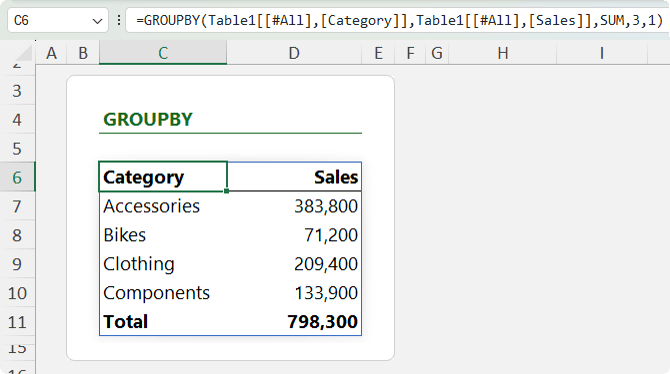
Dynamic array functions are fantastic. GROUPBY can summarise data by category:
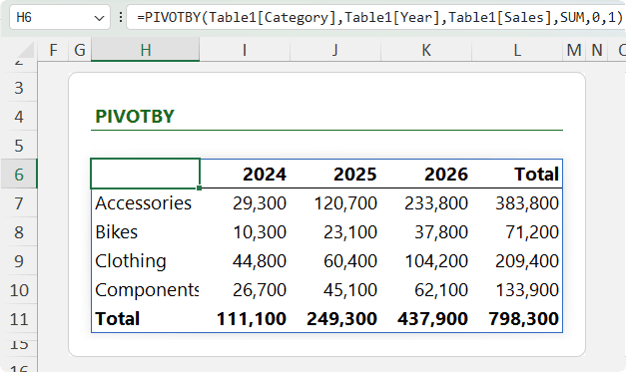
PIVOTBY can create cross-tab style reports:
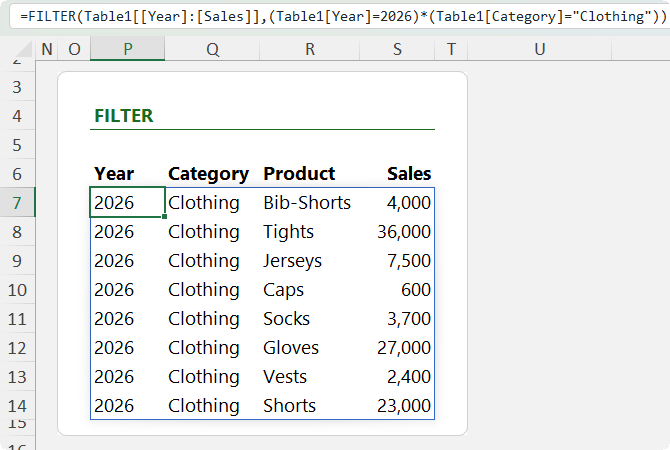
FILTER can return specific records based on criteria:
If you are building a custom formula-driven report with a specific layout, dynamic arrays can be an excellent solution.
But that does not make PivotTables redundant.
PivotTables are still one of the fastest ways to explore and summarise data. In just a few clicks, you can:
- Summarise sales by category
- Split results by year
- Add product detail underneath
- Insert slicers
- Filter the report
- Drill down into a number to see the records behind it
That last point is important. If you double-click a PivotTable value, Excel creates a new sheet showing the underlying records behind that result.
That is incredibly useful when you are still trying to understand the data.
Dynamic array formulas and PivotTables solve different problems.
Use dynamic arrays when you need a custom formula-driven report.
Use PivotTables when you need fast, flexible, interactive analysis.
Excel Myth 4: Excel can only handle small datasets
Excel worksheets have a hard limit.
A worksheet can contain 1,048,576 rows and 16,384 columns.
So yes, the grid has a limit.
But Excel as a tool is not limited to small datasets.
If you try to load millions of rows directly into a worksheet, you will hit the row limit. But you do not have to store large datasets in the worksheet grid.
Instead, you can use Power Query to connect to and shape the data, then load it to the Power Pivot Data Model.
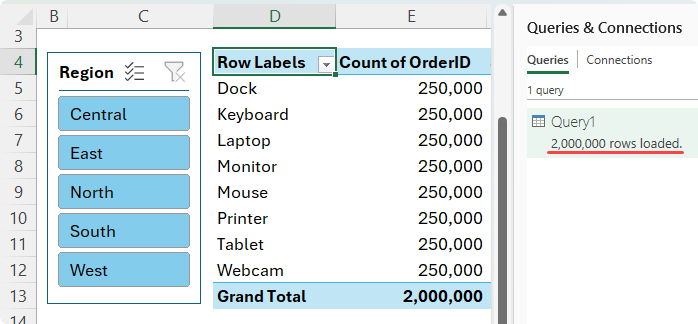
The Data Model can store and analyse much larger datasets than the worksheet grid can hold. Once the data is loaded there, you can build PivotTables, charts, slicers and DAX measures based on that data.
This completely changes how you should think about Excel and large datasets.
The worksheet is not always the destination for your data. Sometimes it is just the reporting layer.
For large datasets, a better workflow is:
- Use Power Query to connect to the data.
- Clean and transform the data.
- Load it to the Data Model.
- Analyse it with PivotTables, charts, slicers and DAX measures.
So the real limitation is not simply “Excel can only handle small datasets.”
The more accurate statement is:
The worksheet grid has a row limit, but Excel’s data tools can work with much larger datasets when you use Power Query and the Data Model.
Excel Myth 5: Avoid whole-column references in formulas
Whole-column references are another piece of Excel advice that gets repeated without enough context.
You may have been told never to use formulas like:
=SUM(Data!D:D)
or:
=COUNTIF(Data!D:D,">10000")
This advice comes from a real performance concern.
In older versions of Excel, worksheets had far fewer rows. Since Excel 2007, the worksheet grid has expanded to 1,048,576 rows. That means formulas that force Excel to evaluate an entire column can have a lot more cells to process.
But whole-column references are not automatically bad.
For simple functions like SUM, COUNT, COUNTIF, SUMIF and some SUMIFS formulas, Excel can often handle whole-column references efficiently because it recognises the used range in the column rather than blindly processing every row.
So formulas like these can be perfectly reasonable when the column is clean:
=SUM(Data!D:D)
=COUNTIF(Data!D:D,">10000")
But this kind of formula is different:
=SUMPRODUCT(Data!D:D,Data!E:E)
SUMPRODUCT processes the arrays you give it. With whole-column references, you are asking it to process over a million rows in each column.
If you repeat formulas like that across lots of cells, the calculation load can add up very quickly.
Whole-column references can also create accuracy risks when the column contains headings, notes, totals, old data, or future entries that should not be included.
The better rule is:
Whole-column references are fine for simple formulas where the column is clean and the function handles the range efficiently. For heavier formulas like SUMPRODUCT, array formulas, complex conditional logic, or formulas repeated many times, use an Excel Table or a properly bounded range instead.
Want to get better at advanced Excel formulas?
If this kind of formula nuance is exactly what you want to get better at, my Advanced Excel Formulas course is designed for you.
It covers lookup functions, dynamic arrays, logical formulas, error handling, text functions, named ranges and more, with practice files so you can apply what you learn straight away.
You also get support from me when you need help.
Excel Myth 6: Never format whole rows or columns because it will make your file huge
This myth sounds logical.
The idea is that if you format an entire row, column, or worksheet, Excel must store formatting information for every single cell, making the file huge.
But that is not always how it works.
Formatting a large range of individual cells can create a lot of stored formatting information, especially if the formatting is inconsistent or fragmented.
However, when you apply formatting at the row or column level, Excel can store that formatting more efficiently because it applies to the row or column as a unit.
Here is an interesting example.
If you format an entire row green, then format one cell in that row purple, it looks like the purple formatting has replaced the green formatting in that cell:

But if you cut that purple cell away and paste it somewhere else, the original green formatting underneath is still there:

That shows Excel is layering the formatting. The row-level formatting remains underneath, while the cell-level formatting sits on top.
The takeaway is this:
Consistent whole-row or whole-column formatting is fine.
What you want to avoid is fragmented formatting across large cell ranges far outside the actual data.
That kind of messy formatting can bloat files and cause unexpected behaviour, especially if it extends far beyond the used range.
Excel Myth 7: Saving as .xlsb always makes a file better
Excel Binary Workbook files, or .xlsb files, are often recommended as a quick fix for large or slow workbooks.
And sometimes, they help.
An .xlsb file can reduce file size and improve open and save speed, especially with large, formula-heavy workbooks.
But the key word is sometimes.
The result depends on what is inside the file.
Some workbooks compress very well as .xlsx files. Others benefit more from the binary format. In some cases, an .xlsb version can even be slightly larger than the .xlsx version.
So file size alone is not enough reason to automatically save everything as .xlsb.
Here is how the formats compare.
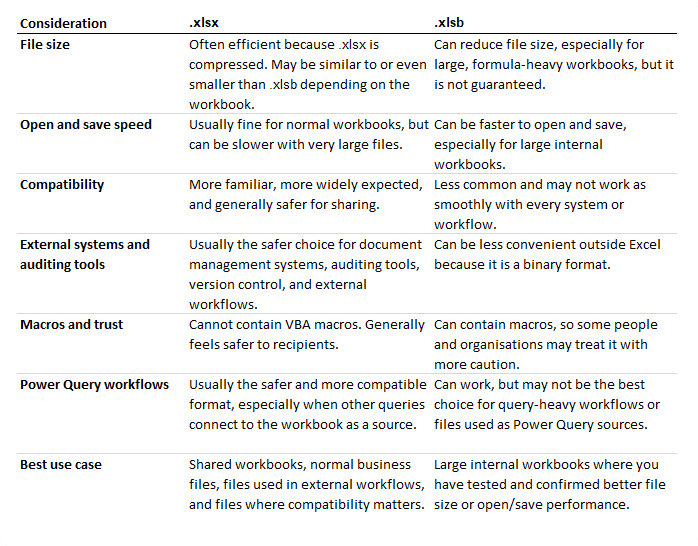
The better rule is:
Use .xlsb when you have a large internal workbook and you have tested that it genuinely improves file size or performance.
For most shared workbooks, .xlsx is still the safer default.
Excel Myth 8: Helper columns are amateur
Helper columns are sometimes dismissed as a beginner technique.
But that view can lead to worse workbooks.
A single giant formula can look impressive, but it can also be harder to read, harder to debug, harder to audit and easier to break:
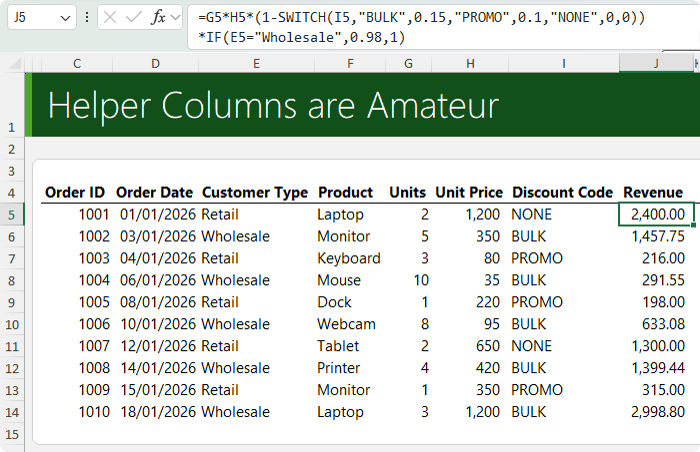
Splitting logic into helper columns can make a workbook clearer and more maintainable:
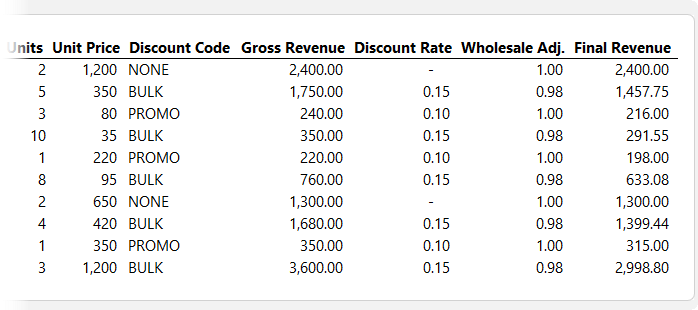
Helper columns are useful because they let you:
- Test each step of the calculation
- See intermediate results
- Reuse logic instead of repeating it
- Make formulas easier for other people to understand
- Reduce the risk of errors
- Improve performance in some cases
Performance can improve because Excel can calculate intermediate results once, rather than repeating the same logic inside multiple formulas.
For example, instead of writing one enormous formula that cleans text, checks a condition, performs a lookup, calculates a result and handles errors all in one cell, you can split those steps into separate columns.
That makes it easier to see where the logic fails if the answer is wrong.
Helper columns are not amateur.
They are often the professional choice because they make workbooks clearer, faster and easier to maintain.
Excel Myth 9: You need VBA to automate Excel
For many years, VBA was the main automation tool in Excel.
If you wanted to automate a task, you recorded a macro or wrote VBA code.
VBA is still powerful and still useful. It is especially valuable when you need:
- Buttons
- Custom workbook behaviour
- Event-driven actions
- User forms
- Code that interacts directly with the Excel interface
- Actions that respond when someone changes a cell
- Processes that create PDFs, clear forms, or move data between sheets
But automation in Excel is much broader than VBA now.
The best automation tool depends on the task.
Use Power Query for repeatable data cleaning
If you clean and reshape the same export every month, Power Query is usually a better fit than VBA.
It is ideal for tasks such as:
- Importing CSV files
- Removing unwanted columns
- Changing data types
- Splitting text
- Combining files from a folder
- Merging tables
- Reshaping data
- Repeating the same cleaning steps every month
Power Query lets you build the process once, then refresh it next time.
Use Excel Tables for automatic expansion
If the task is automatically expanding formulas when new rows are added, you may not need code at all.
An Excel Table can do that for you.
When you add new rows to a Table, formulas, formatting and structured references can expand automatically.
Use formulas, PivotTables and slicers for dynamic reports
If you want a report that updates when inputs change, formulas, Tables, PivotTables and slicers may already provide the automation you need.
For example, you can build a report where users select a region, category, month, product or salesperson, and the results update automatically.
That is automation, even though no VBA is involved.
Use VBA for interface-driven workbook automation
If you want a button that clears a form, creates a PDF, moves data to another sheet, opens a custom user form, or responds when someone changes a cell, VBA may be the right tool.
VBA is still excellent for workbook-specific automation that needs to interact with the Excel interface.
Use Office Scripts or Power Automate for cloud workflows
If the task needs to run in Excel online, connect to other apps, or trigger a workflow in the cloud, Office Scripts or Power Automate may be more appropriate.
These tools are better suited to modern cloud-based workflows, especially where Excel needs to interact with email, SharePoint, Teams, OneDrive, forms, approvals, or scheduled processes.
The myth comes from treating automation as one thing.
But automation can mean many different things, and each job has a different best tool.
The lesson behind these Excel myths
Most Excel myths start with a small piece of truth.
Volatile functions can slow workbooks down.
Tables may be present in slow files.
Whole-column references can be inefficient in certain formulas.
Formatting large areas can bloat workbooks.
.xlsb can improve file size or performance in some cases.
VBA is powerful.
But the problem is when these ideas turn into blanket rules.
Excel is more nuanced than that.
The better approach is to ask:
- What is Excel calculating?
- How many times is it calculating it?
- Is the range larger than necessary?
- Is the workbook being shared with others?
- Is the feature actually causing the problem, or is it just present in the file?
- Is there a better tool for this specific job?
That mindset will help you build faster, cleaner and more reliable Excel workbooks.
Frequently asked questions about Excel myths
Are volatile functions bad in Excel?
Volatile functions are not automatically bad. A few volatile formulas are usually fine. They become a problem when they are used thousands of times, especially inside complex formulas or large calculation chains.
Do Excel Tables slow down workbooks?
Excel Tables themselves are usually not the problem. Slow workbooks are more often caused by inefficient formulas, excessive conditional formatting, volatile functions, large array calculations, or formulas referencing unnecessarily large ranges.
Are PivotTables still useful in modern Excel?
Yes. Dynamic array functions are excellent for custom formula-driven reports, but PivotTables are still ideal for fast, flexible and interactive data analysis.
Can Excel handle more than 1 million rows?
The worksheet grid is limited to 1,048,576 rows, but Excel can analyse larger datasets using Power Query and the Power Pivot Data Model.
Should I avoid whole-column references?
Whole-column references are fine in some simple formulas, such as SUM, COUNT and COUNTIF, when the column is clean. Avoid them in heavier formulas like SUMPRODUCT, complex array formulas, or formulas repeated many times.
Does formatting whole rows or columns make Excel files huge?
Consistent row-level or column-level formatting is usually fine. Fragmented formatting across large ranges far beyond the actual data is more likely to cause file size and performance issues.
Is .xlsb always better than .xlsx?
No. .xlsb can be useful for large internal workbooks when testing shows it improves file size or performance. For most shared workbooks, .xlsx is usually the safer and more compatible choice.
Are helper columns bad practice?
No. Helper columns often make formulas easier to understand, test, audit and maintain. They can also improve performance by avoiding repeated logic.
Do I need VBA to automate Excel?
No. VBA is still useful, but many automation tasks are better handled with Power Query, Excel Tables, formulas, PivotTables, Office Scripts or Power Automate.


Another thought about helper columns is that, if they do not need to be physically shown, and if perhaps desired specifically NOT to show them, but also you are forbidden helper columns, if you properly (“clearly” “logically” “lay out in order”) use LET to build the column arrays and then make a nice, clear calculation at the end, you have most of the effect of helper columns without physically having them, so no squeezing them in somewhere.
A downside is that sometimes those arrays cannot be used directly for some outputs. Occasionally an output requires you work with a RANGE, not an ARRAY. And vice versa, so that’s on your side here. Often this happens when you’d be introducing two dimensionality into things. (Aggravating that that happens even when logically a function should never have been built if its logic REQUIRES two dimensionality but it was always going to refuse it. For instance, applying TEXTSPLIT to a column, hoping to do it as a single array function, not 28,245 copy and paste formulas. So this does rear its ugly head.)
But as the article continuously maintains, your enemy is needless complication. So the simple helper column will often be the clear winner.
Yes, I agree. A helper sheet can be a good compromise when you can’t safely change the structure of an existing worksheet, especially in older workbooks where inserting columns might break references, macros, reports, or user habits.
LET can also be a great alternative because it lets you build the logic step by step inside one formula, almost like invisible helper columns. The trade-off is that it can be harder for other users to inspect, and as you mention, some functions still expect ranges rather than arrays.
So I think the main point is exactly that: helper columns aren’t amateur. They’re one of several ways to make logic clearer. Whether the best choice is a helper column, helper sheet, LET, Power Query, or something else depends on the workbook and who needs to maintain it later.
Regarding Helper Columns, if one absolutely cannot add them into the natural places for them (and there ARE reasons that is sometimes true), one can simply add a sheet to the workbook… a Helper Sheet.
And place helper formulas on it. More or less as easily findable for examination, and now you’re not an evil gnome tearing into a 20 year old spreadsheet’s physical structure.
To be honest, the bosses refusing to let certain important spreadsheets not be edited for structural improvement cannot really be automatically blamed if their real reason really is the degree of mistakes a new or modified spreadsheet often has. Because they DO often have exactly that. (Not that the sacrosanct version doesn’t also… but that doesn’t count, right?)
One thought that comes to mind regarding .xlsb vs. .xlsx is that one suspects the usual “it’s really an XML file” weakness with passwords does not apply in the .xlsb file’s case.
If so, one could gain much better password security for the finer grained password protections available. As in not defeated by trivial efforts.
I have not tested this, just am assuming since the binary format is surely in no way an XML file somewhere in its saved or in use existence. Surely. I mean… that’d just be silly if it were…
Of course, no guarantee that if it is saved out as a .xlsx file that the saver could not then find the passwords in question trivially available.
Well, a simple test creating a file, filling a cell, recording a macro to copy, paste, and edit it, then saving as a .xlsb seems to protect against that. Hmm… no, at first it did, but now I am (inexplicably, considering I could not at first (or “at second”)) now able to edit the macro. So no making a macro to prevent saving as an .xlsx, then getting it protected from editing. And I cannot find a protection setting that protects macros from edits. (Sigh.)
Still, I’ll post this and perhaps someone else will see something I’m missing in that respect.
Interesting thought. My understanding is that .xlsb changes the storage format, but it doesn’t turn Excel’s worksheet/workbook protection into true security. File-level encryption is the proper security option, and that applies separately from the “protect sheet/workbook structure” features. Those finer-grained protections are mainly to prevent accidental or casual changes, not to protect sensitive content from someone determined to bypass them.
For VBA, I’d treat the project password the same way: useful as a deterrent, but not robust security. So I wouldn’t choose .xlsb on the basis of better password protection. I’d still choose the file type based on size, performance, macro support and compatibility.